Biodegradable Ireland - for bags that don't cost the earth

Welcome to Biodegradable.ie - the website from Polybags UK dedicated to Irish customers who want to do their bit for the environment.
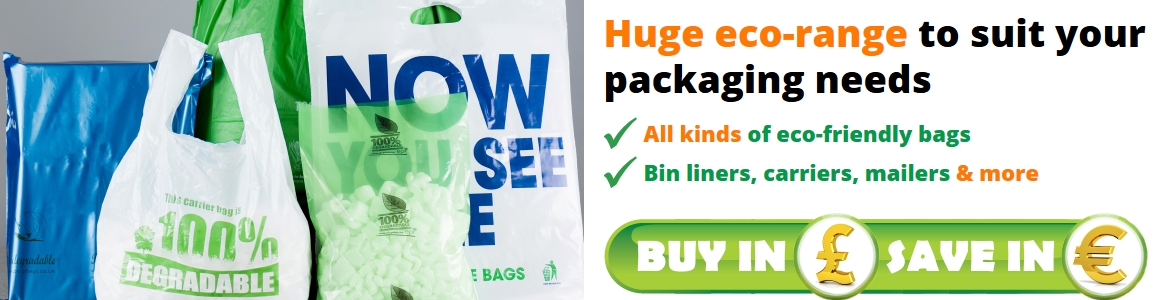
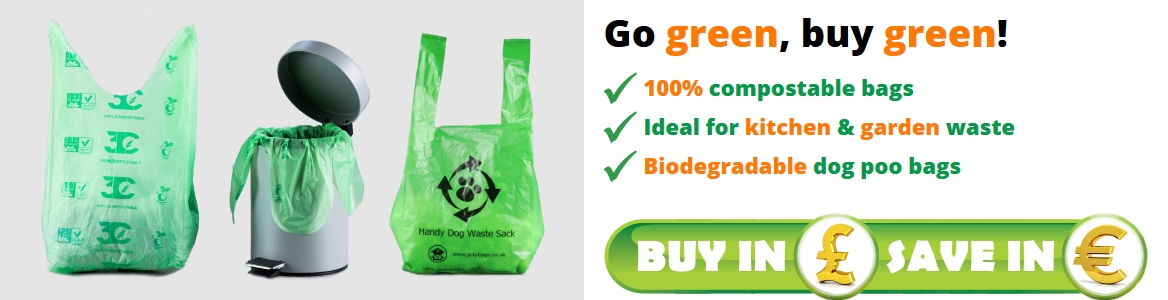
As the UK's number one manufacturer of polythene packaging and eco-friendly alternatives, Polybags has a marketing-leading range of green packaging, including compostable and biodegradable ranges, plus products made from 100% recycled material and carbon-neutral, renewable bioplastic.
Whether you're looking for compostable carrier bags, 100% recycled mailing bags or carbon-neutral packing bags, you'll find all the eco-products you need at Polybags.
We offer fast delivery to Ireland plus no VAT and great savings on bulk orders for Irish customers.
Buy in pounds, save in Euros - with a big buy-in-bulk bonus
With Sterling's weakness in the currency market, your Euros go further, so you can buy in pounds and save in Euros!
New customs regulations and increased courier costs mean that small orders do cost a little more post-Brexit, but Polybags' Irish customers who buy in bulk can still take advantage of free delivery to Ireland.
All orders over £180 come with fast and free delivery - add to that the favourable exchange rate and you've got yourself a bulk-buy packaging bargain!
Our green credentials
Polybags take environmental matters very seriously. As a responsible packaging manufacturer, we understand the responsibility we have as a company, both to our environment and to the generations who will inhabit our planet in the future.
We manufacture a huge range of eco-friendly packaging that minimises environmental impact, whilst still enabling you to get the job done with the minimum of fuss, including a wide range of fully compostable products made from natural, starch-based bio-polymers.
We operate a 100%-recycling principle, with manufacturing processes designed to minimise waste wherever possible. We collect all waste in-house and use it to make new products, unless doing so is less energy-efficient than disposing of it.
Our eco-packaging range is expanding all the time, with our compostable, biodegradable and 100%-recycled ranges now accompanied by many products made from renewable material and our innovative I'm Green carbon-neutral range.
Latest news and views on biodegradable packaging
Biodegradable plastic mulches are chosen when field cover has to do its job amid the growing period and then smash down without a separate retrieval step. That changes the all handling equation, because the film has to balance strength, gauge, and tear resistance against the need to fragment and decompose after use. If the material is also weak, it splits in fitting and leaves gaps around the crop. If it is also heavy or slow to smash down, it behaves also much like normal polythene suppliers and creates more stop-of-life work than intended. The proper spec relies on soil type, season length, and cultivation method, so the film must be matched to the crop cycle rather than treated as a normal wrap.
Industry Sectours Using Green Packaging
Green packaging demand is rising fastest in food, drink, healthcare and special care because these sectours face constant pressure on hygiene, shelf life and public scrutiny. A pack may need to keep safe a product, transport transparent information, and still see responsible when it reaches the client, which means the material selection carries proper weight on the line and in the warehouse. In practice, that can mean thinner board, recycled content, lighter gauge film, or a structure that uses less secondary packing without upsetting seal quality or pallet stability. The optimal options are the ones that still dash cleanly through converting and fill lines, because a green claim that causes waste, delays or handling damage soon loses its value.
Bags » Environmental Bags
A cotton environmental bag requirements the proper construction as much as the proper message, because the material behaves quite differently from a film bag on press and in storage. Print sinks into the fibres rather than sitting on top, so edge sharpness relies on how well the converting is controlled, and a heavier cloth build changes all from pallet count to picking speed. If the gauge is also light, seams and handles soon become the weak point; if it is also heavy, transport and warehousing costs creep up for no proper earn. The sensible selection is one that matches the load and the method the bag will in reality be used.
Get Customised Eco-Friendly Bags & Promote Your Brand
Eco-friendly bags only do the job when the material, gauge and sealing method are matched to the method the pack will in reality be handled. A mono-material polythene suppliers bag can assist recycling, and a paper-based option may suit a few uses, nevertheless neither copes well if the film is also light for the fill weight or the seal is weak for the load. Thin film can stretch on the line, split in the warehouse or lean badly when palletised, while an above-heavy spec only adds unnecessary material. A proper converting dash retains tension proper and seals tidy, so the finished bag grasps together through packing, dispatch and storage without creating avoidable waste.
Compostable Bags Glad
Compostable bags need to be judged first on how they behave with damp food waste, because that is where a weak bag quickly turns into a handling problem. A superb bag should grasp peelings, tea bags and other kitchen scraps without softening also early, and it requirements enough strength for carrying to the caddy or outside bin without splitting at the seam. The optimal versions also assist retain odours and leaks below control, which makes indoor assortment far less messy. If the material is badly chosen, the all system becomes awkward and unhygienic, so bag performance determines whether compostable sorting works in proper use.
STOCK OXO-DEGRADABLE BAGS
Degradable bags need to be matched to the job, because size and print quality affect how well they work on the line and in the field. A bag that is also big wastes material and can see untidy in use, while one that is also small risks overstretching or poor closure. Rotogravure printing gives a clean method to transport emblems, batch details and handling instructions without smudging, which matters when packs are moved quickly through packing, storage and dispatch. If the graphics are sharp and the format suits the product, the pack does its job without causing additional handling problems.
Biodegradable bags only make sense when the film can survive normal handling without becoming fragile on the shop floor or in transit. A bag that tears at the select-face, splits on a rough case edge, or weakens when the seal is manufactured also hot creates waste long before it reaches any composting system. That means gauge control, puncture resistance and seal quality matter only as much as the label on the pack. For products with seeds or other loose material inside, the bag also has to transport the load without shedding fine debris or risking pollution. A format that lasts through dispatch and then smashs down in a managed waste stream is doing its job properly.
EarthFirst Films by Sidaplax manufactures PHA home compostable packaging film
Home compostable film only works in practice if the material retains pure pack performance while still breaking down in the proper conditions. A PHA film can open up more stop-of-life options for flexible packaging, nevertheless the proper test is whether it runs cleanly on converting kit, seals properly, and survives filling, transport, and shelf life without adding waste through rejects or damaged packs. If the gauge, stiffness, and film tension are gross, the all line feels it, from poor web control to weak seal quality and uneven pack presentation. A compostable spec has to earn its place by behaving like a proper packaging material first.
Global Food Biodegradable Packaging Market 2018 Industry Analysis, Size, Share, Strategies and Forecast To 2025
Degradable packaging only performs well when the material selection matches the product, storage time and disposal route. A pack that beginnings breaking down also soon can fail in the warehouse, while one that grasps together properly throughout its planned life can still reduce the load on disposal systems. In food packaging, that means looking beyond the label and checking seal quality, moisture resistance, stiffness and how the film or board behaves in transit. Some formats suit short shelf-life products and light secondary packing, while the rest are also weak for rough handling or long distribution chains. The proper specification protects the contents without creating avoidable waste.
Why degradable or biodegradable packaging?
Biodegradation is the process by which organic substances are broken down by the enzymes produced by living organisms.
The website Packagingknowledge.com states: "Conventional plastics do not break down. Litter and landfill waste may take years to degrade. Another problem with ordinary plastics is that anything contained within them may not reach their full degradation potential. This results in a needless waste of valuable landfill space."
Based on the material used, bioplastics can take varying lengths of time to totally compost, but usually biodegrade up to 60% within 90 to 180 days. It is also important to know the differences between degradable, biodegradable and compostable.
Compostable
"Capable of undergoing biological decomposition in a compost site as part of an available program, such that the plastic is not visually distinguishable and breaks down to carbon dioxide, water, inorganic compounds, and biomass, at a rate consistent with known compostable materials (e.g. cellulose) and leaves no toxic residue." - American Society for Testing & Materials (ASTM).
So in order for a plastic to be called compostable it needs to meet three rules:
- It needs to be able to biodegrade, i.e. it needs to break down into carbon dioxide, water and biomass at the same rate as cellulose (paper)
- The material has to fully disintegrate, i.e. be indistinguishable in the compost
- Eco-toxicity - the biodegradation must not produce any toxic material so that the compost can support plant growth
Biodegradable plastic
Biodegradable plastic is one which can be chemically degraded via natural effectors such as soil bacteria, weather, plants or animals.
Note that there is no requirement for leaving no toxic residue, as well as no requirement for the time it takes to biodegrade.
Degradable plastic
By definition, this term refers to a plastic film containing a controlled percentage of an appropriate non-toxic, non-tinting additive, which will enable the plastic film to totally degrade when exposed to aerobic or anaerobic conditions, including when disposed in a landfill or other regulated dumping area, and within such period of time as specified.
A plastic therefore may be degradable but not biodegradable or it may be biodegradable but not compostable, i.e. it breaks down too slowly to be called compostable or leaves toxic residue.